
Living in Mexico as a temporary or permanent resident brings rights, benefits and also clear immigration responsibilities. One of the most important —and often underestimated— is always carrying your resident card. Many foreigners leave this document at home “to keep it safe”, without knowing it can become a problem if an unexpected immigration check happens.
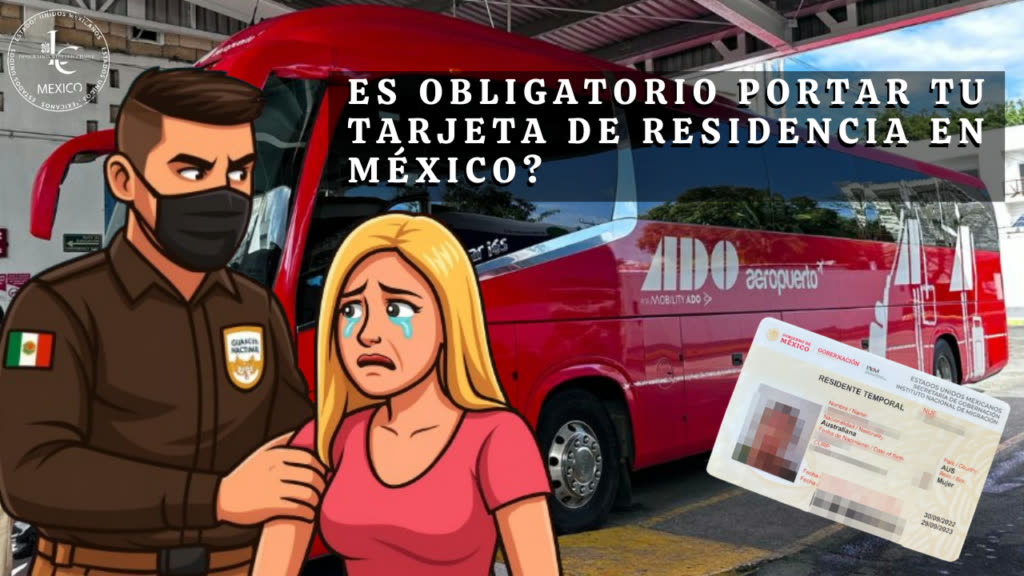
It is not an everyday event, but the National Immigration Institute (INM) can carry out random checks, and if they find you without a document that proves your legal stay, the situation can become uncomfortable, confusing and stressful. Being prepared is the difference between a quick check and a real headache.
What is the resident card and why is it your most important immigration document?
The INM resident card is the official document that proves you have a valid legal stay in Mexico. It is not just an ID; it is the immigration equivalent of your legal status in the country.
Unlike your passport, which proves your nationality, your resident card proves your right to be in Mexico under a specific status: temporary or permanent. Without it, you cannot immediately show that your stay is regular.
Is it mandatory to carry your resident card in Mexico?
Legally, yes. The Mexican Immigration Law states that foreigners must be able to prove their immigration status when a competent authority asks for it.
This does not mean the INM checks people every day, but if a check happens and you do not have your card, not carrying it can be read as:
- Failure to prove a legal stay
- Incomplete information
- A need for additional verification
All of this can be avoided with one habit: carrying your card with you.
Random immigration checks: when, how and why they happen
Immigration checks are not frequent, but they do happen. They usually take place:
- During specific operations
- At strategic checkpoints
- After reports or routine reviews
Many residents say the same thing: “it doesn’t happen often, but when it does, you’d better be prepared”. During these checks, INM officers can ask for:
- FMM (for visitors)
- Valid resident card
It is not an accusation; it is an administrative check.
What can happen if you are not carrying your resident card
Not carrying your card does not automatically mean a penalty, but it does open the door to complications, such as:
- Temporary administrative holds
- Being taken to an office for verification
- Lost time and needless stress
In some cases, the authority may require you to prove your status later, which means extra procedures that could have been avoided.
FMM vs. resident card: common mistakes
A frequent mistake is thinking that:
- The FMM replaces the card (it does not)
- A digital copy is enough
- Your passport is enough
👉 If you are a resident, your valid document is your resident card.
Common myths about carrying immigration documents
“They never check”
False. It is not common, but it does happen.
“A photo is enough”
Not always. The authority can ask for the physical document.
“It’s dangerous to carry it”
It is more dangerous to be unable to prove your status.
Real benefits of always carrying your resident card
Carrying your card:
- Gives you peace of mind
- Avoids misunderstandings
- Speeds up checks
- Reinforces your legal compliance
It is a simple action that protects your immigration stability.
Conclusion
Carrying your resident card in Mexico is not exaggeration or paranoia: it is smart prevention. Immigration checks exist, and when they happen, being prepared changes everything.
It is not about living in fear, but about living informed. Meeting your obligations as a resident lets you enjoy Mexico with peace of mind, certainty and legal security.
👉 Check right now: do you have your card with you?
For more guides, practical tips and real cases, follow me on:
📌 YouTube: Immigration with Luis Chable
📌 Facebook: Immigration Service with Luis Chable
Questions about your case?
Every immigration case is different. In a consultation I review your case and give you a clear written plan. In English, Spanish or French.
Sigue leyendo
Más guías que te pueden servir
Visas · Francia
Visa PVT: vivir y trabajar 12 meses en México siendo francés
Así funciona el Programa Vacaciones y Trabajo entre México y Francia, y lo que nadie te dice sobre trabajar con esta visa.
Trabajo
¿Cómo obtener la residencia en México por oferta de empleo?
Una de las vías más usadas para vivir y trabajar legalmente en México, y uno de los procesos más mal entendidos.
Unidad familiar
¿La unidad familiar permite traer a tu esposa o hijos a México?
Muchos creen que la única forma de obtener residencia es demostrar ingresos altos. La unidad familiar es otra vía.
Ciudadanía
Cómo obtener la ciudadanía mexicana en 2026
Si ya tienes residencia temporal o permanente, este es el siguiente paso: cómo convertirte en ciudadano mexicano.
Keep reading
More guides you may find useful
Visas · France
PVT visa: live and work in Mexico for 12 months as a French citizen
How the Working Holiday Program between Mexico and France works, and what nobody tells you about working with this visa.
Work
How to get residency in Mexico through a job offer
One of the most common paths to live and work legally in Mexico, and one of the most misunderstood.
Family unity
Family unity: can you bring your spouse or children to Mexico?
Many people think the only way to get residency is to prove a high income. Family unity is another path.
Citizenship
How to get Mexican citizenship in 2026
If you already have temporary or permanent residency, this is the next step: how to become a Mexican citizen.